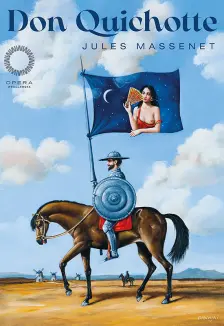
The opera Don Quichotte by Jules Massenet (1842-1912), a work composed for the libretto by Henri Cain and first staged in 1910 at the Opéra de Monte-Carlo, is one of the striking examples of the transfer of the literary thread into the circle of musical theater. The composer, along with the librettist in his heroic comedy, only indirectly refers to the famous novel by Miguel de Cervantes. Henri Cain created the text based on another play entitled Le Chevalier de la Longue Figure (The Knight with a mournful face) from 1904. The five-act work in its form fits into the traditions of the French grand opera.
Don Quichotte, directed by Marek Wiess-Grzesiński, is not a comedy, but a serious reflection on the state of the world today. The action of the opera is set in modern times, which shows the timeless message of the work. The director points out that: “Massenet's opera itself has little to do with the literary prototype of Cervantes, the original novel is ironic, grotesque, mocking. The opera libretto, on the other hand, goes the other way, and we must not forget that it is above all French music, that is, an opera about love, and that of desperate love.” Marek Weiss-Grzesiński adds that it will not be a staging clinging to the times in which it was created, but it will be a living story, affecting today's audience. Weiss-Grzesiński points out: “A theater is not a museum or a cinema with reconstruction. Theatre must be contemporary, otherwise I don't believe it. The most important thing is the truth of the encounter: the spectator-actor, and the theater itself is lived.”
Opera Wrocławska
Don Quixote - Jules Massenet
Tickets
Sold by: opera.wroclaw.pl
50-250 PLN
Go to opera.wroclaw.pl ↗You will be redirected to the partner's website in a new tab.
The opera Don Quichotte by Jules Massenet (1842-1912), a work composed for the libretto by Henri Cain and first staged in 1910 at the Opéra de Monte-Carlo, is one of the striking examples of the transfer of the literary thread into the circle of musical theater. The composer, along with the librettist in his heroic comedy, only indirectly refers to the famous novel by Miguel de Cervantes. Henri Cain created the text based on another play entitled Le Chevalier de la Longue Figure (The Knight with a mournful face) from 1904. The five-act work in its form fits into the traditions of the French grand opera.
About the event
Comments
Log in to add a comment
Log in
No comments yet
Be the first to comment