In the final years of Pyotr Tchaikovsky's life, contrasting with the fame, respect and recognition surrounding him was the growing despondency of the artist. Without creative work, life turned out to be impossible for him. When the director of the capital's theaters of St. Petersburg became the educated and artistically talented, very sympathetic to the composer Ivan Vsevolozhsky, he directed numerous orders to Tchaikovsky for operas and ballets. The last eight years of Tchaikovsky's life include the creation of such great works as the operas Dama Pikowa and Jolanta, and the ballets Sleeping Beauty and the Nutcracker.
The French translation of E. T. A. Hoffmann's The Nutcracker became the inspiration for Tchaikovsky to compose a ballet for the libretto by Marius Petipa and Ivan Vsevolozhsky. He began writing ballet in 1891, and on March 23, 1892, the score was ready. The Nutcracker was first performed on December 6, 1892 at the Mariinsky Theater, choreographed by Lev Ivanov.
From the point of view of the development of the genre, the ballet The Nutcracker represents a transitional stage between the symphonic music of Swan Lake and Sleeping Beauty and puppet ballet performances such as Toy Boxes by Debussy and Parsley Stravinsky. (Arnold Alszwang PWM 1979)
The first post-war Polish performance of The Nutcracker choreographed by Rajmund Sobiesiak took place in Bydgoszcz on 10 April 1958. It was an important, even historical event in the history of Bydgoszcz musical theatre: the first independent, full-length ballet performance by the Opera Studio. Subsequently, this ballet appeared on the poster of the Bydgoszcz Opera in 1986 (choreography: Przemysław Śliwa) and was played on the stage of the Polish Theater for a dozen years.
The current realization in the choreography of a real ballet star, the outstanding dancer and choreographer Paul Chalmer, is impressive.
Paul Chalmer - dancer, choreographerBorn in Ottawa, Canada. He studied dance at the National Ballet School of Canada. His fascination with the ballets of choreographer John Cranko was the motivation to leave his homeland and join the Stuttgarter Ballett in 1980, where three years later he became a soloist, dancing many leading roles. He has also performed as a guest soloist at The English National Ballet, The Birmingham Royal Ballet, The Scottish Ballet, The London City Ballet, Teatro Colon in Buenos Aires, Teatro dell' Opera di Roma and at Milan's Teatro alla Scala. He danced in choreographies by Georges Balanchine, Jiří Kylián, Kenneth MacMillan, John Neumeier, William Forsythe and Uwe Scholz.
In 1999, Paul Chalmer became ballet master of the Sächsische Staatsoper Ballett (Semperoper) in Dresden, and in 2000, at the invitation of Uw Scholz, ballet master of the Leipziges Ballett. He also made his debut as a choreographer. From 2005 to 2010 he was the director of the ballet troupe of the Leipzig Opera. For Leipziger Ballett he created productions such as Swan Lake (2005), The Nutcracker (2007), Firebird (2008), Giselle (2009) and Parsley (2009).
In 2010, Chalmer created a new, full-scale choreography for the Roman Opera on the occasion of the 200th anniversary of Fryderyk Chopin's birth. In 2011, he choreographed Swan Lake for Maggio Danza, premiered at the Maggio Musicale Fiorentino festival. In November 2013, a ballet troupe at the Conservatoire National Supérieur de Musique et de Danse in Paris staged his Romeo and Juliet.
In 2014, the Ballet of the Grand Theatre in Poznań prepared the premiere of Cinderella Prokofiev choreographed by Paul Chalmer, and in May/June 2014 the ballet of the Roman Opera - Sleeping Beauty. Another Cinderella was realized by Chalmer at the Dworzak National Theatre in Ostrava in April 2015.
A few questions for Paul Chalmer- Who is the most important character in The Nutcracker?
Clara (or Maria, as she is called in the literary original) is certainly the central character of The Nutcracker. Her imagination takes her to the crucial moment that determines her adulthood, when Clara discovers within herself the feelings that transform her from a child into a woman. Uncle Drosselmeier and his gift, the Nutcracker, his transformation into a prince and the journey that follows, not only help Clara to see the dreams that open the door to adulthood, but also encourage her not to stifle curiosity and not to abandon the imagination of her childhood.
- You danced the role of Prince in The Nutcracker in choreographies by Schaufuss, Stevenson, Darell. Which of the projects is most interesting and inspiring to you?
The nutcracker has been a part of my life since my childhood years. It was in Grandpa... that I first appeared as a child on stage with the National Ballet of Canada. Later I danced the roles of the Prince or the Bachelor of the Sugar Fairy.
Although I have danced and seen hundreds of performances of this ballet over the course of my career, I cannot judge its meaning and structure any other than from the moment I myself began preparing for my own production for the Leipziger Ballett in Germany in 2007. Of course, the psychologically dark side of the original story of Hoffmann and then Alexander Dumas have been altered in numerous realizations of the ballet, whose action leaves the original story After Act I. I think a lot has been lost in the dramaturgic layer and characterization of the characters.
What has impressed me a lot in the numerous productions of The Nutcracker in which I have danced or watched as a spectator are the unique visual worlds created by great scenographers such as Jurgen Rose, Desmond Heeley, David Walker or Nicholas Goergiadis. Although, without a doubt, choreography is decisive, I think that the strength of the impact of the dramatic and visual aspects influences the success and success of this magical journey in which we invite the audience.
- What is the inspiration in your work?
Without a doubt, the inspiration in my work on The Nutcracker is the dazzling music of Tchaikovsky. This brilliant score and his other scores, Sleeping Beauty and Swan Lake, revolutionized ballet music at the end of the 19th century to such an extent that today we cannot imagine the world of ballet without them. Even if I listen to it for the thousandth time, it remains a great source of inspiration.
- What role of the first soloist in classical ballet is your favorite?
Albert in Giselle has always been one of my favorite roles. Also the title role in John Crank's ballet Onegin, which I performed in my career. I loved dancing in George Balanchine's ballets.
- Tradition or modernity: what attracts you more in today's ballet?
I believe that choreographers, applying modern dance techniques and styles to the technique of classical ballet, made a huge contribution to its development. Thus, completely new means of expression and repertoire were created (Tetley, Forsythe, Kylian, McGreggor etc.). This in turn challenged the dancers to be more open and versatile than before.
I believe that this versatility positively informs the way in which dancers approach a purely classical repertoire, also adding physicality, subtlety and dynamism to them, but we must be very careful about polluting the style. This new physicality is also in some way detrimental to the classics. Dancers seem to strive for an almost acrobatic quality of performance that deforms - in my opinion - ballet, making it sometimes difficult to distinguish a dancer from a gymnast.
I hope this is a passing fad for dancers and dance makers and that we can soon leave this kind of soulless circus outside the theater and let our souls dance again!
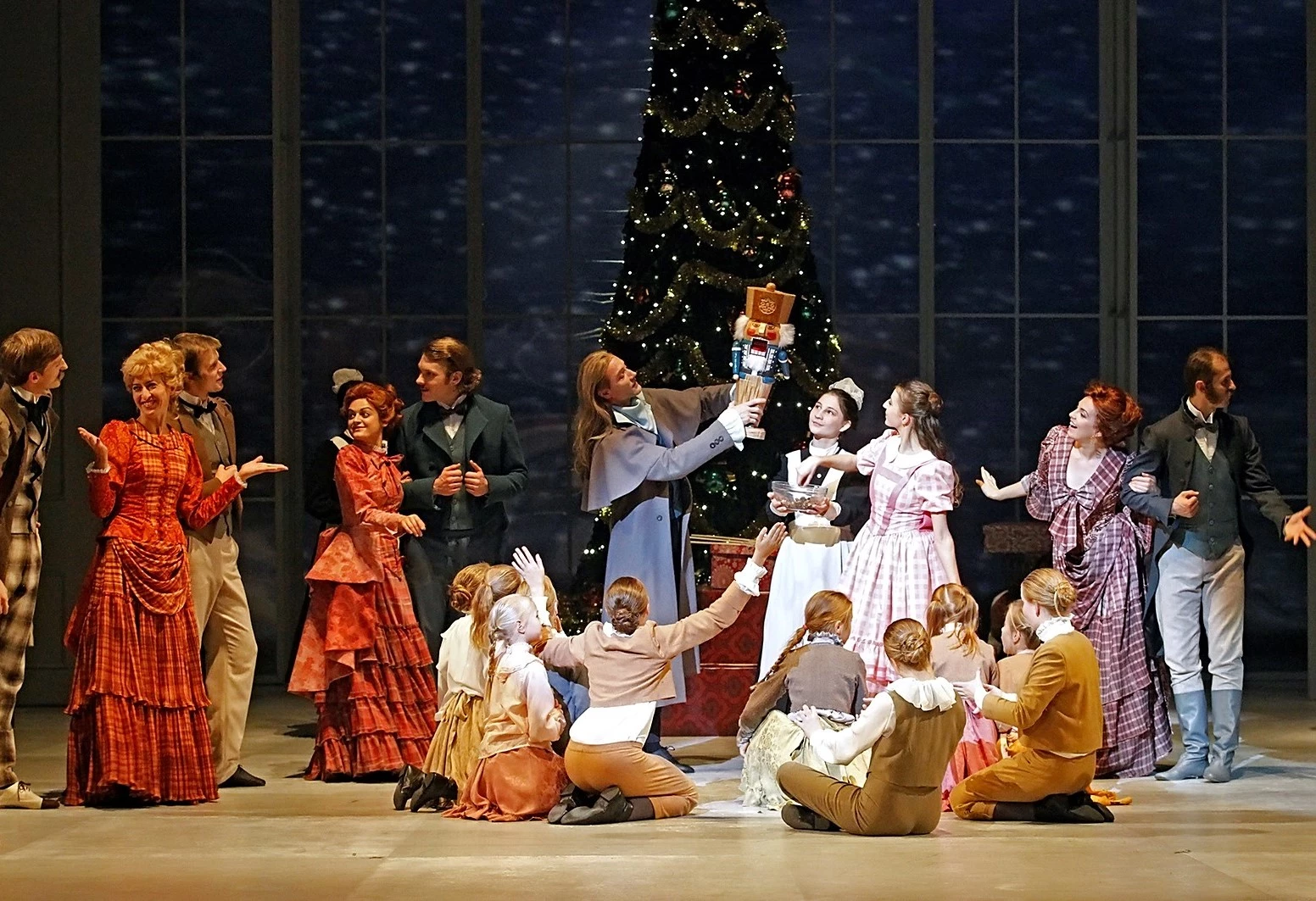
Opera Nova
NUTCRACKER
Tickets
Sold by: opera.bydgoszcz.pl
Go to opera.bydgoszcz.pl ↗You will be redirected to the partner's website in a new tab.
In the final years of Pyotr Tchaikovsky's life, contrasting with the fame, respect and recognition surrounding him was the growing despondency of the artist. Without creative work, life turned out to be impossible for him. When the director of the capital's theaters of St. Petersburg became the educated and artistically talented, very sympathetic to the composer Ivan Vsevolozhsky, he directed numerous orders to Tchaikovsky for operas and ballets. The last eight years of Tchaikovsky's life include the creation of such great works as the operas Dama Pikowa and Jolanta, and the ballets Sleeping Beauty and the Nutcracker.
About the event
Comments
Log in to add a comment
Log in
No comments yet
Be the first to comment