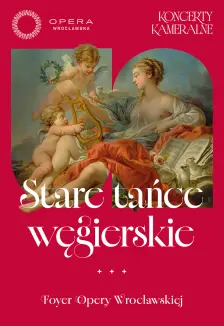
Old Hungarian Dances
Sold by: bilety.opera.wroclaw.pl
50-70 PLN
Go to bilety.opera.wroclaw.pl ↗You will be redirected to the partner's website in a new tab.
Anton Reich (1770-1836) is sometimes called the “father of the wind quintet”. He created 24 such compositions for flute, oboe, clarinet, horn and bassoon that revolutionized chamber music. These works are characterized by bold harmony, polyphony and outstanding treatment of each instrument as a soloist. During the concert we will hear the Wind Quintet in E flat major, Op. 88, No. 2 — considered the most popular in all Reichy's oeuvre. Then the Old Hungarian Dances of the 17th century by the 20th century composer Ferenc Farkas (1905-2000) will be performed. In the 1940s, the composer became interested in ancient Hungarian musical manuscripts, in which he found works and songs recorded in the form of tabulations from the 14th to the 18th centuries. Fascinated by simple yet extremely catchy melodies, he decided to arrange and elaborate them in order to save them from oblivion. Finally, we will hear the song Trois Pièces Brèves (Three Short Songs). This is an extremely lively and popular chamber composition for woodwind quintet, fran
About the event
Comments
Log in to add a comment
Log in
No comments yet
Be the first to comment